Subscribe to Our Newsletter
To get the latest tips and news to support your well-being journey!

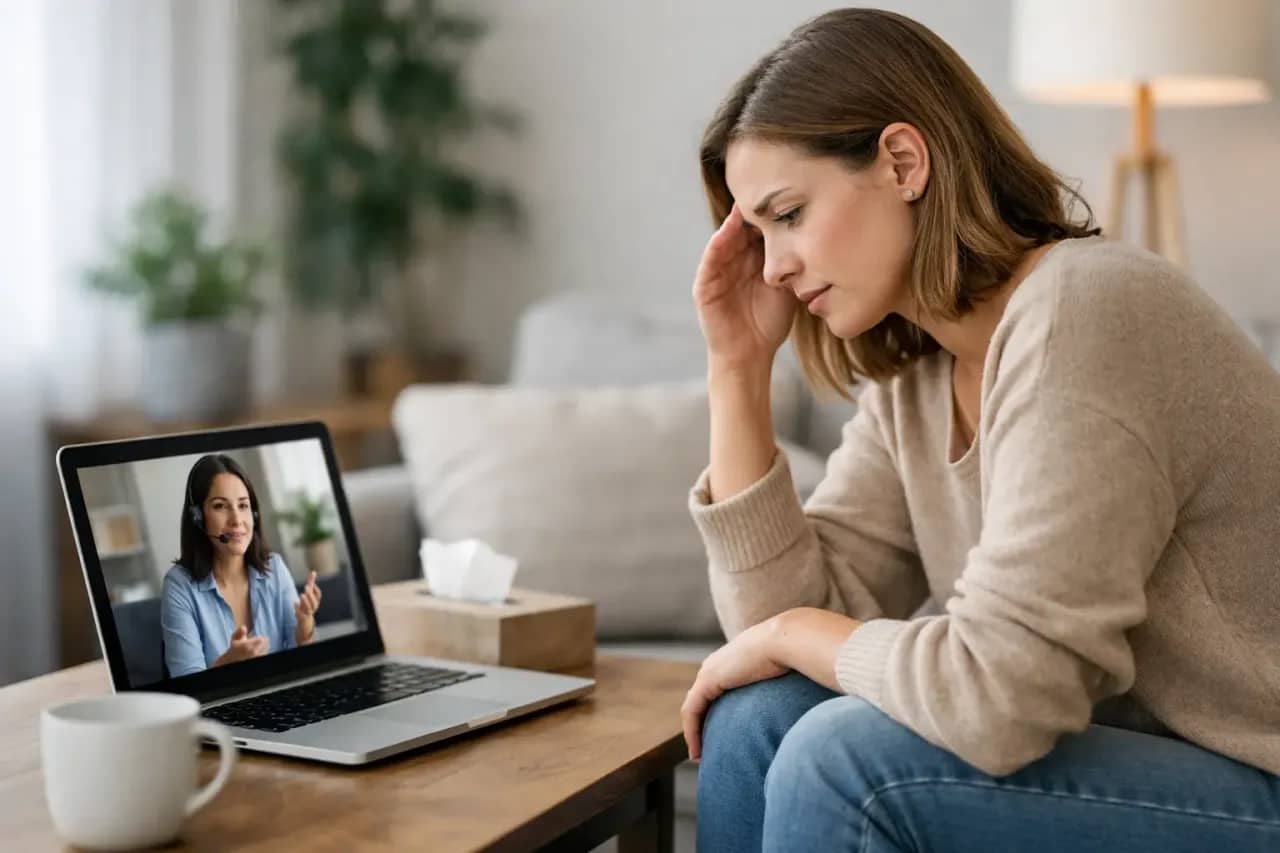
Anxiety rarely arrives at a convenient moment. It shows up before a presentation, at 2am when sleep should have come hours ago, or halfway through a normal Tuesday when your chest tightens and your thoughts start racing. For many people, online therapy for anxiety feels less like a trendy option and more like the first realistic way to get support without turning life upside down.
That matters, because anxiety is not one thing. It can look like constant overthinking, panic, avoidance, irritability, perfectionism, digestive issues, or the nagging sense that you are always behind. The right support helps you make sense of what is happening, not simply push through it.
Traditional therapy can be deeply valuable, but it is not always easy to access. Travel time, limited local availability, long waiting lists and the awkwardness of fitting appointments around work or caring responsibilities can all become barriers. If you are already anxious, extra friction is often enough to make you delay getting help.
Online therapy removes some of that pressure. You can speak to a qualified professional from home, during a lunch break, or from any private space where you feel comfortable. That flexibility is not a minor perk. For working professionals, parents and people dealing with burnout, it can be the difference between starting support now and postponing it for another six months.
Privacy also matters. Some people feel more able to open up when they are in familiar surroundings rather than a clinical setting. Others appreciate the discretion of attending sessions without anyone knowing they left the office early. Anxiety often feeds on anticipation, so making therapy easier to access can lower the threshold for taking the first step.
In many cases, yes. Online therapy can be highly effective for anxiety, especially when the therapist is well matched to your needs and uses approaches with a strong evidence base. Cognitive behavioural therapy is one common example, helping people notice unhelpful thought patterns, test assumptions and respond differently to anxiety triggers. Other approaches may focus more on emotional regulation, nervous system awareness, past experiences, or relationship patterns.
What matters most is not whether the session happens through a screen or in a room. It is the quality of the therapeutic relationship, the skill of the practitioner and whether the approach fits your situation. A thoughtful therapist can help you understand what is fuelling your anxiety, identify patterns that keep it going and build practical ways to respond.
That said, online therapy is not identical to in-person support. Some people love the comfort and convenience. Others find it harder to focus on video, struggle to find a private space, or simply feel more connected face to face. If your anxiety includes severe risk, complex crisis needs, or symptoms that require immediate in-person assessment, online support may need to sit alongside other forms of care rather than replace them.
Good therapy does not just tell you to breathe more or think positively. Anxiety is often intelligent, protective and deeply rehearsed. It develops for reasons, even when those reasons no longer serve you.
A strong online therapist will usually start by helping you map your experience. When does the anxiety spike? What do you fear will happen? What do you do to cope, and which coping strategies help only briefly? That kind of exploration can feel surprisingly relieving. There is power in realising your anxiety follows patterns, because patterns can be understood and changed.
From there, support becomes more practical. You might learn how to spot spiralling thoughts before they gather speed, reduce avoidance without overwhelming yourself, calm physical symptoms, set healthier boundaries, or challenge the perfectionism that keeps your nervous system in overdrive. If burnout, poor sleep, isolation or relationship stress are making anxiety worse, those factors deserve attention too.
This is where a holistic platform can be especially useful. Anxiety does not live in a silo. It can affect how you sleep, eat, work, move and relate to other people. In some cases, progress comes faster when therapy is supported by wider wellbeing care rather than treated as a standalone fix.
The ease of online access is a gift, but choice can also be overwhelming. If every profile starts to blur together, focus on fit rather than perfection.
Start with the issue itself. Are you dealing with generalised anxiety, panic attacks, social anxiety, work stress, health anxiety or a mix of several things? A therapist with relevant experience is more likely to understand the shape of what you are facing. It also helps to look at their style. Some people want structured, goal-led sessions with clear strategies. Others want more reflective support that explores deeper emotional patterns.
Practical details matter more than many people expect. Think about session times, cost, platform security and whether the therapist offers a pace that suits you. Weekly sessions can be ideal at the start, but not everyone wants the same rhythm. Affordability matters too. Therapy only helps if you can sustain it long enough to benefit from it.
It is worth paying attention to how a therapist makes you feel even in early contact. Do they seem clear, calm and respectful? Do you feel rushed, confused or overly sold to? Trust is not built by polished language alone. It comes from feeling safe enough to be honest.
Many people worry about the first appointment more than anything that comes after it. They wonder whether they will say the wrong thing, cry unexpectedly, or freeze completely. All of that is more common than you might think.
The first session is usually about understanding your concerns, your history and what you want help with. You do not need to have a perfectly organised explanation. A good therapist can help you find the thread, even if your starting point is simply, “I feel on edge all the time” or “I cannot switch my brain off.”
You may also talk about goals. That does not mean setting impossible targets or pretending recovery is linear. It simply means identifying what better might look like for you. Perhaps you want fewer panic symptoms, more confidence at work, better sleep, or less fear around everyday situations. Clear goals can make therapy feel grounded and measurable.
Before the call, it helps to choose a private space, test your internet connection and have water nearby. Small things, but they make the experience smoother. If privacy at home is difficult, headphones and a parked car can be a workable temporary solution for some people.
Online therapy is often a strong fit if you are motivated for support, comfortable using technology and looking for flexibility. It can be especially helpful if anxiety makes travel, waiting rooms or unfamiliar environments feel draining.
It may be less ideal if you have no reliable private space, find screens overstimulating, or need more intensive support than a standard remote session can offer. Some people begin online and later decide they would prefer in-person therapy. Others do the opposite after discovering that home feels safer and more manageable.
There is no gold star for choosing one format over another. The best option is the one you will actually use consistently and honestly.
Anxiety improves through insight, but also through repetition. What happens between sessions matters. You might practise grounding techniques, notice your thought patterns in real time, adjust routines that keep your stress high, or experiment with gentler ways of responding to yourself.
This is one reason integrated platforms such as SympathiQ can make sense for people whose anxiety overlaps with burnout, sleep disruption, lifestyle strain or relationship stress. Having access to broader specialist support can help you work on the whole picture rather than just one symptom at a time.
If you are considering online therapy for anxiety, you do not need to wait until things become unbearable. Support is not only for crisis points. It can also be a steady, private way to regain clarity, feel more in control and start moving through life with less fear running the show.
The first step does not need to be dramatic. It only needs to be real.
Your email address will not be published. Required fields are marked *