Subscribe to Our Newsletter
To get the latest tips and news to support your well-being journey!


Stress rarely arrives as one dramatic moment. More often, it shows up as a shorter temper in meetings, a mind that will not switch off at 2am, or that low, constant feeling of being behind. An online stress management coach can help before that pressure hardens into burnout, exhaustion, or a life that feels narrower than it should.
For many adults, the problem is not knowing that stress is an issue. It is knowing what to do about it when work is full-on, family life is demanding, and the usual advice to “rest more” feels wildly out of touch. That is where coaching online starts to make real sense. It brings structured support into your week without adding another commute, another waiting room, or another thing to organise.
 What an online stress management coach actually does
A good coach helps you understand your stress patterns, not just talk about how busy you feel. That might include spotting the triggers that push you into overwhelm, recognising physical warning signs earlier, and building practical ways to respond before things escalate.
This is not about forcing a perfectly calm lifestyle that only works on holiday. It is about creating strategies that fit your real routine. If your hardest moments happen before school drop-off, during back-to-back calls, or late at night when your thoughts start racing, support should be shaped around that reality.
An online stress management coach may work with you on boundaries, workload habits, emotional regulation, sleep routines, communication, confidence, or recovery after periods of high pressure. In some cases, stress is tied closely to burnout, people-pleasing, conflict, or a sense that you have lost control of your own time. Coaching can help make those links clearer.
It is also worth saying what coaching is not. It is not a replacement for medical care, and it is not always the right fit for severe or acute mental health concerns. Sometimes the best support is therapy, GP care, or a more integrated plan. The right practitioner will be honest about that.
Stress has a way of making even small tasks feel heavier. When that is the case, convenience matters more than people like to admit. If support is difficult to access, many people simply put it off until they are struggling far more than they need to be.
Online coaching removes a lot of that friction. You can book sessions around work, join from home, and keep support private and flexible. For professionals, carers, parents, or anyone managing a packed schedule, that ease is not a luxury. It is often the reason support becomes possible at all.
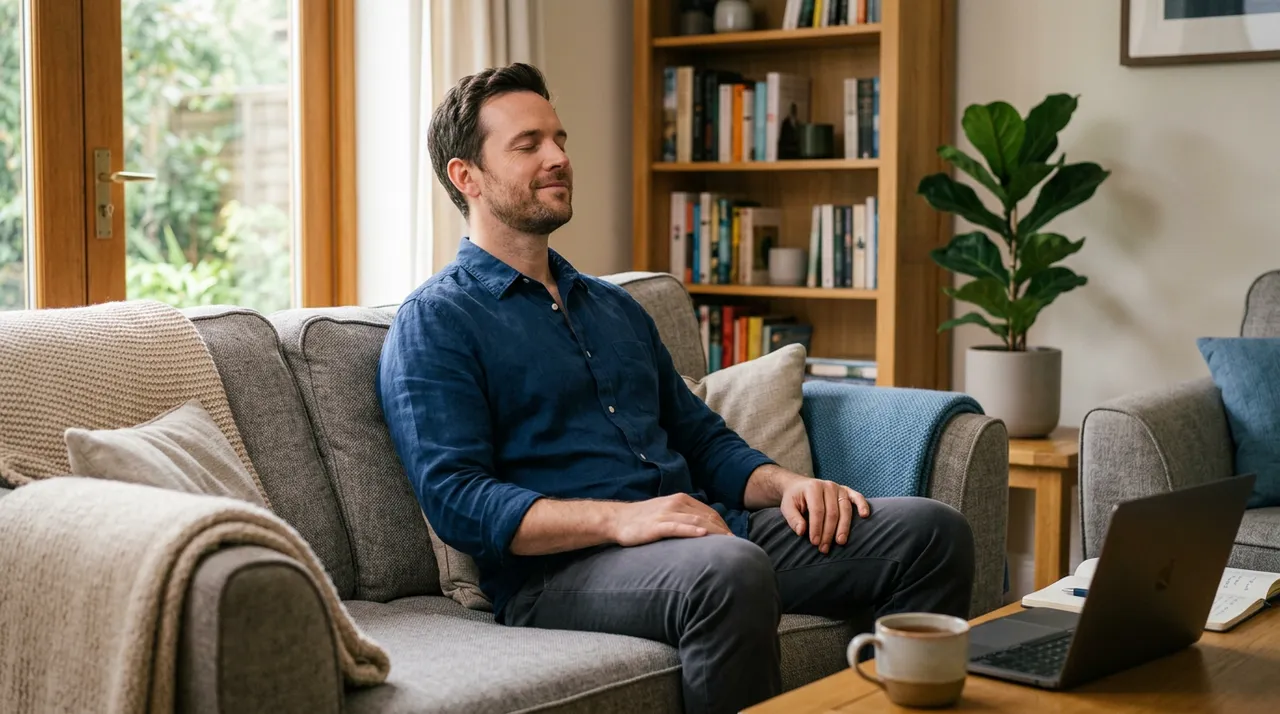
There is another benefit too. People often feel more comfortable opening up from a familiar environment. Sitting in your own space can make it easier to speak honestly about what is happening, especially if you are used to keeping everything together on the outside.
That does not mean online is automatically better for everyone. Some people focus more easily face-to-face, and some prefer the separation of leaving home for an appointment. But if you have avoided getting help because it feels inconvenient, expensive, or too exposed, online coaching can be a strong alternative.
You do not need to be in full burnout to benefit from support. In fact, earlier support is usually more effective. Coaching can be especially useful if you are functioning on paper but feeling stretched underneath it all.
This often includes people who are high-performing at work yet constantly tense, those navigating major life changes, or anyone who feels trapped in a cycle of overcommitting and under-recovering. It can also help if your stress is spilling into your relationships, sleep, eating habits, motivation, or concentration.
Many clients are not looking for abstract insight alone. They want to stop snapping at people they care about, stop waking up with dread, or stop ending each week feeling depleted. They want progress they can actually feel.
 What happens in coaching sessions
Most people worry that coaching will either be too vague or too intense. In reality, the best sessions tend to feel focused, human, and manageable.
You might begin by mapping your current stress load: what drains you, what restores you, where your pressure points sit, and what patterns keep repeating. From there, a coach can help you set goals that are realistic rather than idealised. That may mean learning how to leave work mentally at the end of the day, reduce avoidance, improve recovery time, or handle difficult conversations without carrying them for hours afterwards.
Sessions often combine reflection with action. You might look at thought patterns, routines, habits, and emotional responses, then test small changes between appointments. Those changes matter. Stress management is rarely transformed by one brilliant conversation. It shifts through consistent adjustments that make daily life feel safer, steadier, and more workable.
Depending on the coach, approaches can vary. Some are very practical and habit-led. Others are more reflective, helping you understand the beliefs or pressures sitting under your stress. Neither style is inherently better. It depends on what you need and how you work best.
Credentials and experience matter, but so does fit. You are trusting someone with a part of life that may already feel messy, fragile, or hard to explain. You need to feel safe enough to be honest.
Start with the basics. Look for clear information about the coach’s background, areas of focus, session format, and boundaries of practice. If stress is linked to burnout, work pressure, anxiety, or life transitions, it helps to choose someone who works with those areas regularly.
Then pay attention to how they communicate. Do they seem calm, clear, and grounded? Do they promise instant transformation, or do they talk realistically about change? Big promises can sound comforting when you are overwhelmed, but steady support is usually more valuable than dramatic claims.
It also helps to think about what kind of structure suits you. Some people want accountability and clear action steps. Others need more space to process before they can make changes. A strong platform makes this easier by helping you compare specialists, understand their approach, and book support without jumping through hoops. That is part of what makes digital care models such as SympathiQ appealing - they are built to reduce stress around getting support, not add to it.
Progress is not always dramatic at first. Often it starts quietly.
You may notice that stressful moments still happen, but they do not throw you off for as long. You may recover more quickly after a difficult day. You may start recognising your limits before you hit them. Sometimes the biggest shift is not becoming calm all the time. It is trusting that you can respond to pressure without being consumed by it.
You might also see practical changes: better sleep, fewer spiralling thoughts, more confidence saying no, improved focus, or less guilt around rest. These are not small wins. They are signs that your nervous system and your daily habits are beginning to work with you rather than against you.
If nothing is shifting after a fair period, that matters too. It may mean the coaching approach is not right for you, or that you need a different kind of support. Good care is not about forcing one model to fit every person.
Stress rarely stays in one lane. It affects energy, movement, food choices, mood, relationships, and self-worth. That is why a holistic approach can be so helpful.
For some people, stress management coaching works best alongside nutritional support, fitness guidance, or mental health care. If your stress is tied to poor sleep, low energy, emotional eating, or total disconnection from your body, a broader support network can make change feel more sustainable.
This matters because real wellbeing is interconnected. You are not a list of separate problems to fix one by one. You are a whole person trying to feel better in a life that places demands on your time, attention, and resilience.
Choosing support is not a sign that you are failing to cope. It is a decision to stop carrying so much on your own. If stress has become your normal, an online coach can help you see that normal does not have to stay that way. Sometimes the first step is simply letting someone help you build a calmer way forward.

Your email address will not be published. Required fields are marked *

You do not usually wake up one morning and think, I am burnt out. It tends to arrive more quietly than that. You start dreading messages before breakfast. Small decisions feel oddly heavy. Rest stops feeling restorative, and even the things you used to enjoy begin to feel like tasks. At that point, an online burnout coach can be more than a convenient option - it can be the first form of support that actually fits around your life.
Burnout is often mistaken for ordinary stress, but the two are not the same. Stress can feel intense and unpleasant, yet still temporary. Burnout is what happens when pressure goes on for too long without proper recovery, support, or change. It can affect your energy, focus, sleep, motivation, confidence, and relationships. For many working adults, it also comes with guilt. You may know something is wrong, but still feel pressure to keep performing as if nothing has changed.

An online burnout coach helps you understand the patterns driving your exhaustion and supports you in changing them in a structured, realistic way. That can include workload habits, boundaries, perfectionism, people-pleasing, emotional overload, decision fatigue, and the constant sense that you should be doing more.
This is not simply about telling you to take a bath, go for a walk, or book annual leave. Good coaching looks deeper. It asks why recovery has become so difficult in the first place. It helps you notice where your energy is going, what your body has been signalling, and which expectations are no longer sustainable.
In practice, sessions often focus on a mix of reflection and action. You might look at your weekly rhythms, identify the moments that consistently drain you, and build new ways of working or living that feel possible rather than idealistic. You may also work on communication, especially if saying no, asking for help, or switching off after work feels harder than it should.
Because the support happens online, it is easier to fit into a packed schedule. You can speak to a coach from home, during a break, or around caring responsibilities. For many people, that reduced friction matters. When you are already exhausted, convenience is not a luxury - it is often the difference between getting help and putting it off again.
Burnout does not only affect senior executives or people in visibly high-pressure roles. It can affect parents, founders, teachers, healthcare workers, freelancers, managers, creatives, and anyone carrying too much for too long. It can also show up in people who seem highly capable from the outside.
An online burnout coach may be a good fit if you are functioning on paper but struggling underneath. Perhaps you are still meeting deadlines, yet everything feels harder than it used to. Perhaps you are snappy at home, disconnected from your own needs, or relying on caffeine, late-night scrolling, and sheer force of will to get through the week.
It can also suit people who want structured support but are not sure therapy is the right starting point. Coaching is often especially helpful when you want practical change, accountability, and a forward-looking plan. That said, it depends on what you are carrying. If your burnout is closely tied to trauma, severe anxiety, depression, or a mental health crisis, therapy or clinical care may be more appropriate, either instead of coaching or alongside it.
That nuance matters. Burnout support is not one-size-fits-all, and trustworthy platforms should make that clear rather than oversimplify the process.
This is one of the most common questions, and the honest answer is that it depends on your needs.
A therapist usually works with mental health symptoms, emotional history, deeper patterns, and psychological healing. An online burnout coach is more likely to focus on present-day habits, stress drivers, boundaries, recovery strategies, and sustainable change. There can be overlap, especially when a coach has a strong wellbeing background, but the purpose is different.
If you feel emotionally overwhelmed but stable, and your main goal is to stop running on empty and rebuild balance, coaching can be a strong option. If you are feeling persistently low, panicked, numb, or unsafe, a licensed mental health professional may be the better route. Some people benefit most from a holistic setup that includes both.
That is where integrated care becomes especially valuable. Burnout rarely sits neatly in one box. It can affect sleep, movement, nutrition, self-worth, relationships, and your ability to think clearly. Support works best when it recognises the whole person rather than only one symptom.
Not every coach who mentions burnout is equipped to support it well. The quality of the relationship, the structure of the process, and the coach's understanding of stress patterns all matter.
Look for someone who can explain how they work in clear terms. You should be able to understand what sessions involve, what kinds of goals they help with, and what is outside their scope. A good coach will not make dramatic promises or suggest they can fix everything in a few calls. Burnout recovery is rarely linear, and ethical support reflects that.
It also helps to find a coach whose style suits you. Some people respond well to gentle accountability and reflective conversation. Others want something more direct and practical. Neither is inherently better, but the fit can shape how safe and motivated you feel.
Privacy, scheduling flexibility, and ease of booking matter too, particularly when you are already stretched. A platform such as SympathiQ can make that process feel less overwhelming by bringing specialist discovery, secure booking, and ongoing support into one place. That simplicity can lower the barrier to taking the first step.
Burnout recovery is not usually dramatic at first. Often, the earliest changes are subtle. You may notice that your chest feels less tight on Sunday evenings. You start finishing work without carrying it mentally into the night. You become more aware of what drains you before you hit a wall.
Working with an online burnout coach should help you feel more resourced, not more judged. Over time, you may find it easier to make decisions, set limits, and recognise your needs without immediately dismissing them. You may also start measuring progress differently - not just by output, but by steadiness, clarity, and how sustainable your life feels.
That is an important shift. Burnout often trains people to value themselves only through productivity. Recovery asks you to build a healthier metric.
When you are exhausted, even small logistical hurdles can feel too much. Travelling across town, rearranging your day, sitting on a waiting list, or repeating your story to multiple providers may all be enough to delay support.
Online care removes much of that pressure. It gives you a private, flexible way to speak to someone without adding another draining task to your week. That does not make it lesser than in-person support. For many people, it makes support more consistent, and consistency is what creates change.
There is also something reassuring about being able to access help in the environments where burnout often shows up most clearly - your home office, your kitchen table, your normal weekday routine. The work becomes easier to apply because it is rooted in real life rather than separated from it.
Still, online coaching is not magic simply because it is accessible. It works best when you are ready to engage honestly, experiment with change, and give yourself permission to be supported.

A lot of people wait until they are completely depleted before seeking help. They tell themselves they should be able to handle it alone, or that someone else has it worse. That mindset is common, but it can keep you stuck for far longer than necessary.
You do not need to prove that you are struggling enough to deserve support. If your energy is low, your patience is thin, your motivation has fallen away, and rest no longer seems to help, that is already worth paying attention to. An online burnout coach can help you make sense of what is happening before it spills into every part of your life.
The most helpful starting point is often the simplest one: notice what feels unsustainable, and do not minimise it. Support does not have to come after a crisis. Sometimes it begins with the quiet decision to stop pushing past your own limits and start listening to them instead.

You do not usually wake up one morning and realise burnout has arrived in full. It tends to show up in smaller ways first - the Sunday dread that starts on Friday, the short temper over tiny requests, the feeling that even simple admin is somehow too much. If you are searching for how to recover from burnout, chances are you are not lazy, failing, or bad at coping. You are depleted, and your mind and body are asking for a different approach.
Burnout is more than feeling tired after a busy week. It is a state of prolonged emotional, mental, and often physical exhaustion, usually caused by chronic stress without enough recovery. For some people it is tied to work. For others it is parenting, caring responsibilities, financial pressure, relationship strain, or trying to hold everything together for too long. That matters, because recovery is not just about rest. It is about understanding what drained you, what is keeping you stuck, and what support will actually help.

One of the hardest parts of burnout is that the instincts that got you through it often make recovery slower. You may try to power through, optimise your routine, or tell yourself you just need a better attitude. That can work for ordinary stress. Burnout is different.
Recovering well usually means doing three things at once. First, reducing the pressure that is overwhelming your system. Second, rebuilding your physical and emotional capacity. Third, changing the patterns that made burnout possible in the first place. Miss one of those and the relief may only be temporary.
This is also where many people get frustrated. They take a few days off, sleep more, and expect to feel like themselves again. If you have been running on adrenaline for months, a weekend will not repair that. Recovery is rarely instant, and it is not linear. Some days you will feel clearer, then unexpectedly flat again. That does not mean you are going backwards.
Start with honesty. Ask yourself what feels unsustainable right now. Not what should be manageable, but what genuinely feels too heavy. Burnout recovery begins when you stop arguing with your own limits.
If possible, lower your load before you focus on self-improvement. That might mean speaking to your manager, pausing non-essential commitments, delaying a big decision, or asking family members to take on more. Many people think they need to become stronger before they reduce demands. In reality, reducing demands is often what makes strength possible.
Next, stabilise the basics. This sounds simple, but when someone is burnt out, basics are often exactly what has been lost. Sleep needs protecting, not squeezing in around everything else. Meals need to be regular enough to keep your energy steady. Movement should support your nervous system rather than punish your body. A gentle walk, stretching, or light strength work may help more than forcing yourself through intense training when you are already exhausted.
It also helps to notice the forms of rest you are actually missing. Sleep is one type, but not the only one. You may need mental rest from constant decision-making, emotional rest from being the reliable one, sensory rest from screens and noise, or social rest from always being available. Someone can sleep for eight hours and still feel worn down if every other part of their life is overstimulating.
 Look at the cause, not just the symptoms
A lot of advice on burnout focuses on coping tools, and those can be useful. But if the root problem stays untouched, your system stays under threat. The real question is not just how you feel. It is why recovery has become necessary.
For some people, the answer is workload. For others, it is lack of control, unclear expectations, loneliness, perfectionism, people-pleasing, or never feeling safe enough to switch off. Sometimes burnout grows from a mismatch between your values and how you are living. If your days are full but none of it feels meaningful, exhaustion can hit harder.
This is where reflection matters. Notice what drains you fastest and what restores you most reliably. Notice where resentment shows up. Notice which responsibilities are real and which ones you picked up out of guilt, fear, or habit. You do not need to solve your whole life in one week, but you do need to get curious. Burnout often thrives in autopilot.
Many adults experiencing burnout are highly capable people others depend on. That can make boundaries feel uncomfortable, especially if you are used to being helpful, available, and competent. But if your energy is being consumed faster than it can be restored, boundaries are not selfish. They are a health requirement.
That may mean saying no without over-explaining. It may mean setting clearer work hours, turning off notifications, or resisting the urge to answer every message immediately. It may mean being less emotionally on-call for everyone around you.
The trade-off is real. Better boundaries can disappoint people at first. You may worry about seeming difficult or less committed. Even so, staying endlessly accessible often comes at a much higher cost. The goal is not to become rigid. It is to stop treating your own capacity as optional.
Burnout can be isolating because it often comes with shame. You may think you should have managed better, or that other people are coping fine. That comparison is rarely helpful. Many people who look fine are struggling more than they show.
Support can make recovery shorter and safer. Depending on what is driving your burnout, that support might come from a therapist, burnout coach, GP, nutrition professional, manager, or trusted friend. Sometimes what you need is emotional processing. Sometimes you need structure. Sometimes you need practical accountability to rebuild habits that fell apart when survival mode took over.
A holistic approach is often more effective than focusing on just one area. If your sleep, stress, eating patterns, movement, and self-talk are all affected, it helps to work with support that sees the whole picture. Platforms such as SympathiQ can be helpful here because they make it easier to access different kinds of specialist care in one place, privately and around a busy schedule.
When burnout starts to lift, many people make the same mistake. They feel slightly better and immediately try to catch up on everything. That can send you straight back into depletion.
Instead, think in terms of gradual capacity building. Add back responsibility in stages. Keep some white space in your week. Protect the habits that helped you stabilise in the first place. Recovery is not proved by how quickly you can return to over-functioning.
It also helps to redefine progress. You may not feel brilliant straight away, but progress can look like concentrating for longer, feeling less dread in the morning, being more patient with people you care about, or noticing that your body feels calmer. These changes count.
If you are someone who likes measurable goals, choose gentle ones. Try consistent wake times, one proper lunch break, two evenings a week without work, or one honest conversation about what needs to change. Burnout recovery responds better to consistency than intensity.
Sometimes burnout overlaps with anxiety, depression, trauma, or physical health issues. If your exhaustion feels extreme, your sleep is persistently poor, your mood is very low, or you are struggling to function day to day, it is worth seeking professional support rather than trying to self-manage indefinitely.
There is no prize for handling it all alone. Burnout can affect concentration, memory, motivation, immunity, and relationships. Left unaddressed, it can reshape your life in ways that are much harder to untangle later.
The good news is that recovery is possible. Not always quickly, and not always by going back to the exact person you were before. In many cases, people recover by becoming more honest about their needs, more selective with their energy, and more intentional about how they live and work. That version of recovery is not a compromise. It is often a better foundation than the one that came before.
If you are in the thick of it, take the first step that makes your life feel 10 per cent lighter, not perfect. Burnout rarely lifts through one dramatic change. It softens when you begin treating your wellbeing as something worth protecting every day.